Full-Stack Web Development
Food Options Application
Sep 2026 - Present
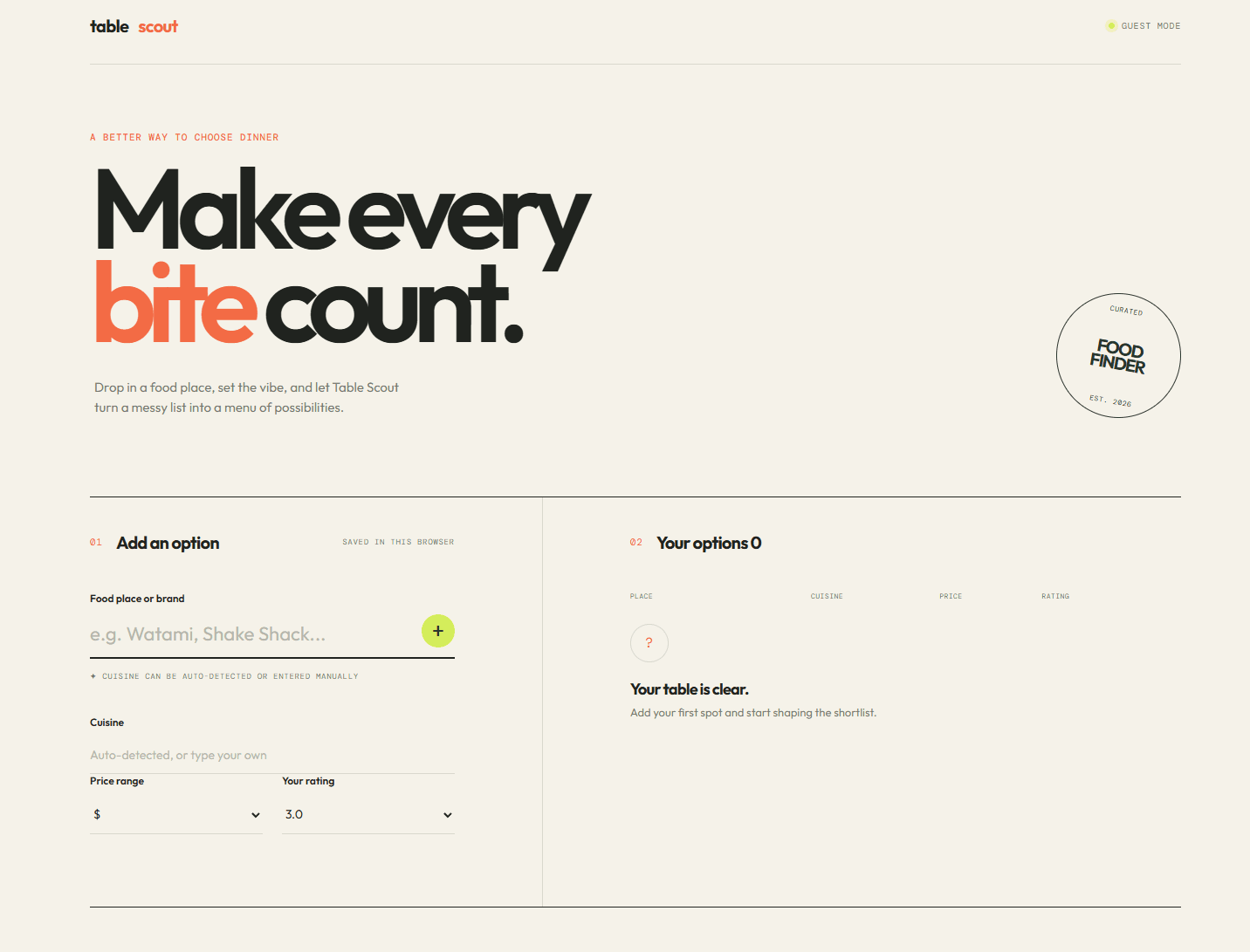
A full-stack food discovery and tracking application that allows users to save, organise, rate, and revisit restaurants and dining experiences.
Project Overview
What I built
The Food Options Application is designed to solve the problem of forgetting restaurants, recommendations, and previous dining experiences. Instead of keeping restaurant ideas across messages, notes, screenshots, and social media, the application provides a structured location where users can organise the places they want to try and the places they have already visited.
Challenge
The problem I needed to solve
The project needed to remain simple enough for everyday use while still having an architecture capable of supporting future user accounts, persistent databases, search features, restaurant categorisation, and mobile development. Security also needed to be considered early so that sensitive API credentials and authentication logic would not be exposed when the application is eventually deployed publicly.
Approach
How I approached it
I built the application using Next.js, React, TypeScript, and Tailwind CSS with a modular architecture separating interface components, application logic, data handling, and future authentication functionality. The application is being designed so temporary local data storage can later be replaced by a persistent multi-user database without requiring a complete rewrite.
Implementation
Key implementation details
- Developed functionality for saving, rating, categorising, and revisiting restaurants and dining experiences.
- Designed reusable React components and a modular Next.js application structure.
- Created a responsive interface supporting desktop, tablet, and mobile screen sizes.
- Separated data storage, authentication, and application logic to support future backend integration.
- Applied security-focused development practices including server-side API credential handling, input validation, and protected authentication design.